



TL;DR
Für Ecwid-Händler, die 2026 auf Amazon, eBay und Etsy expandieren, ist Salestio die erste Wahl: eine Shop-native Integration, die im Ecwid App Market gelistet ist, mit vollständiger Amazon (FBM und FBA), eBay, eBay Motors und Etsy Unterstützung, Echtzeit-Zwei-Wege-Synchronisation und einer veröffentlichten auftragsbasierten Preisliste, die bei $29/Monat beginnt und jeden Marktplatz in einem Plan abdeckt. Koongo bleibt stark für Verkäufer, die eine Abdeckung von über 500 Kanälen und Feed-Management benötigen. M2E Cloud bietet einen großzügigen kostenlosen Starter-Plan und einen Ein-Klick-Weg zu Amazon, eBay und Walmart. Commercium unterstützt über 200 Marktplätze mit einem dauerhaft kostenlosen Plan für kleine Kataloge. Channable eignet sich für Händler, die auch Feed-Management und Unterstützung für Werbekanäle über 2.500+ Ziele benötigen.
Top 5 Marktplatz-Integrations-Apps
Bewertet nach Synchronisierungstiefe, Preistransparenz und Marktplatzabdeckung

Salestio
9.6/10Shop-native Ecwid Marktplatz-Integration für Amazon, eBay, eBay Motors und Etsy. Live im Ecwid App Market.
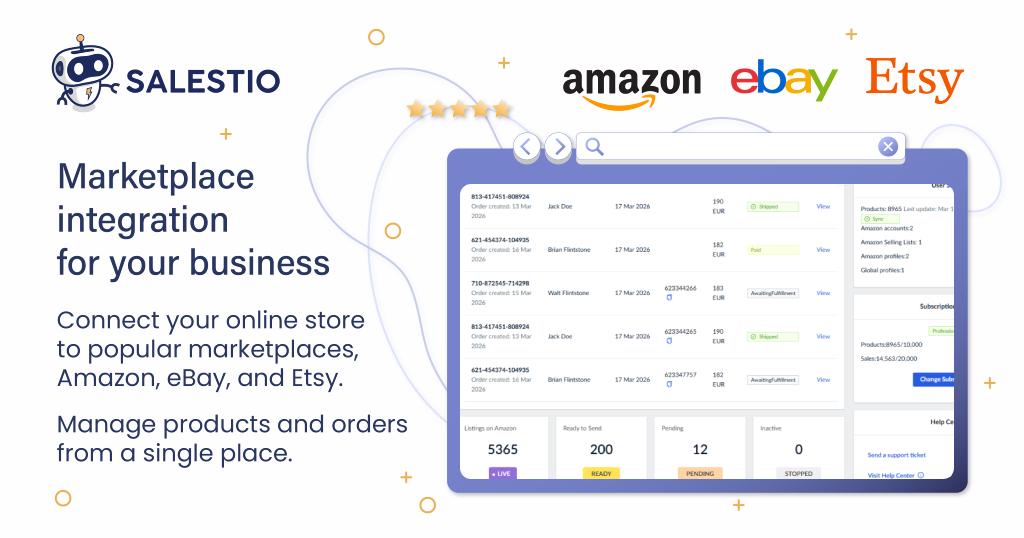
Salestio ist eine vollständig live geschaltete Ecwid App Market Integration, die Ihren Ecwid Shop mit Amazon (FBM und FBA), eBay, eBay Motors und Etsy verbindet. Die bidirektionale Echtzeit-Synchronisation hält Produkte, Preise, Lagerbestände, Bestellungen und Fulfillment über jeden Kanal hinweg konsistent. Der Katalogexport unterstützt die Erstellung neuer Angebote oder die Verbindung mit bestehenden Marktplatz-Produkten; anpassbare Vorlagen und erweiterte Mapping-Optionen decken E-Commerce-Sonderfälle wie eBay KType und ePID ab. Intelligente Rundungsregeln für Preise, QTY-Limits pro Marktplatz und automatischer Bestellimport mit SKU-Mapping runden ein ausgereiftes Funktionsset ab. Die Preisgestaltung ist auftragsbasiert und vollständig veröffentlicht: Starter $29/Monat (100 Marktplatz-Bestellungen/Monat), Growth $79 (500), Scale $199 (3.000), Ultimate $299 (7.000), plus eine Custom-Stufe. Nur Marktplatz-Bestellungen, die in Ihren Shop importiert werden, zählen zum Kontingent, Ihre eigenen Shop-Bestellungen nicht, und ein Plan deckt Amazon, eBay und Etsy ab, ohne Gebühren pro Angebot und pro Marktplatz.

Koongo
9.0/10Breiteste Marktplatz- und Feed-Management-Abdeckung für Ecwid mit über 500 unterstützten Kanälen.
Koongo verbindet Ecwid-Shops mit über 500 Marktplätzen, Preisvergleichsportalen und Werbeplattformen. Die Produkt- und Bestellsynchronisation läuft in konfigurierbaren Intervallen von 5, 15 oder 30 Minuten. Sofort einsatzbereite Kanalvorlagen vereinfachen das Onboarding für Amazon, eBay, Zalando, Miinto und Dutzende regionaler europäischer Marktplätze. Koongo hat seine Preisgestaltung neu strukturiert: Es gibt einen kostenlosen Plan, dann Basispläne zu 35 €, 69 € und 99 € pro Monat, die nach Synchronisationsfrequenz gewählt werden, mit zusätzlichen Nutzungsgebühren für weitere Artikel, Bestellungen, Shops und Marktplätze, sodass die tatsächlichen monatlichen Kosten vom Verbrauch abhängen. Enterprise-Volumen sind nur auf Anfrage erhältlich.
Koongo besuchen →
M2E Cloud
8.7/10Kostenloser Starter-Plan mit Ein-Klick-Amazon-, eBay- und Walmart-Integration für Ecwid-Shops.
M2E Cloud (M2E Multichannel Connect) bietet automatische Produktlistung und Bestandssynchronisation zwischen Ecwid und wichtigen Marktplätzen. Der kostenlose Starter-Plan unterstützt bis zu $1.000 GMV pro Monat und ist somit für kleinere Verkäufer zugänglich. Assistiertes Onboarding und eine 30-tägige kostenlose Testversion bei kostenpflichtigen Plänen reduzieren den Einrichtungsaufwand. M2E Cloud unterstützt auch TikTok Shop, Temu und Kaufland Global.
M2E Cloud besuchen →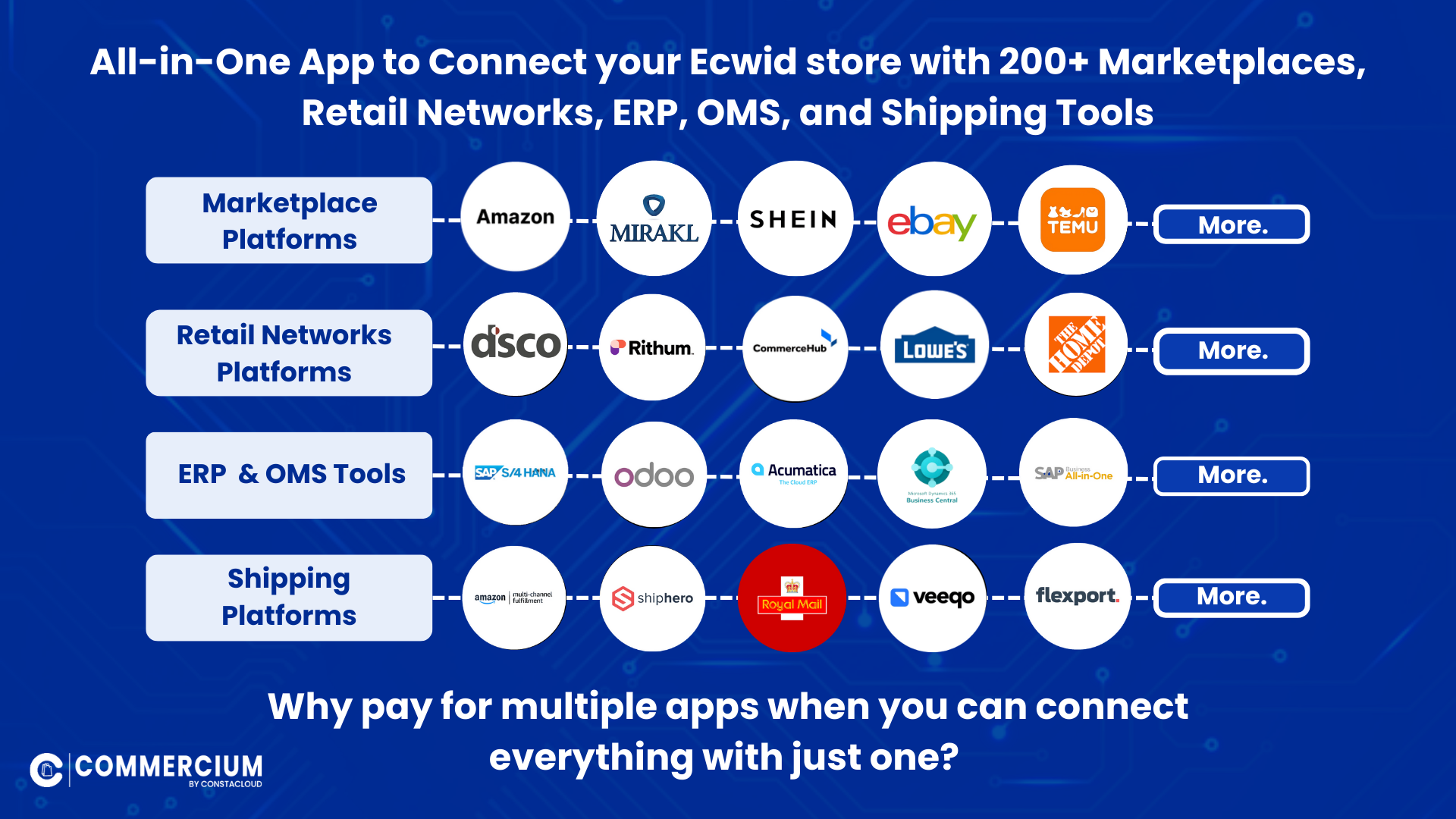
Commercium
8.4/10Über 200 Marktplatz-Verbindungen mit einem dauerhaft kostenlosen Plan und automatischer Produktdatenübersetzung.
Commercium by ConstaCloud überträgt Produktangebote von Ecwid auf über 200 Marktplätze, darunter Amazon, eBay, Etsy, Temu, Shopee und Mirakl-basierte Plattformen. Die Echtzeit-Bestandssynchronisation verhindert Überverkäufe über alle verbundenen Kanäle hinweg. Der kostenlose Plan deckt bis zu 50 SKUs und 10 Bestellungen pro Monat pro Marktplatz ab. Kostenpflichtige Pläne skalieren nach SKU-Anzahl oder Bestellvolumen, mit kostenlosem Onboarding auf allen Stufen und einer 28-tägigen kostenlosen Testversion.
Commercium besuchen →
Channable
8.0/10Feed-Management-Plattform, die Ecwid mit über 2.500 Marktplätzen, Shopping-Engines und Anzeigenkanälen verbindet.
Channable geht über die einfache Marktplatzintegration hinaus, indem es Produkt-Feed-Management, Marktplatz-Listings und PPC-Automatisierung in einer Plattform kombiniert. Ecwid-Produktdaten werden mit wenigen Klicks importiert, mit Echtzeit-Bestands- und Preissynchronisation. Die Plattform zeichnet sich bei europäischen Marktplätzen wie Bol.com, Kaufland, OTTO und TikTok Shop aus. Die Preise beginnen bei $59/Monat mit vier verfügbaren Stufen.
Channable besuchen →Funktionsvergleichstabelle
Direkter Vergleich von Spezifikationen, die echte Käufer vergleichen
| Funktion | Salestio | Koongo | M2E Cloud | Commercium | Channable |
|---|---|---|---|---|---|
| Amazon-Integration | Ja (FBM & FBA) | Ja (alle Regionen) | Ja (alle Regionen) | Ja (alle Regionen) | Ja (alle Regionen) |
| eBay-Integration | Ja (alle Regionen) | Ja (alle Regionen) | Ja (alle Regionen) | Ja (alle Regionen) | Ja (alle Regionen) |
| eBay Motors | Ja | Nein | Nein | Nein | Nein |
| Etsy-Integration | Ja | Nein | Nein | Ja | Nein |
| Walmart-Integration | Nein | Nein | Ja | Nein | Nein |
| TikTok Shop | Nein | Ja | Ja | Nein | Ja |
| Synchronisationsfrequenz | Echtzeit bidirektional | 5/15/30 Min. | Echtzeit | Echtzeit | Echtzeit |
| Bestellmanagement | Nativer Import in Ecwid | Import nach Ecwid | Zentralisiert | Automatischer Push zu Ecwid | Bestellweiterleitung |
| Preisregeln | Intelligente Rundung + komplexe Regeln | Kanalspezifisch | Ja | Ja | Feed-Regeln |
| Kostenloser Plan | 14-tägige kostenlose Testversion für alle kostenpflichtigen Pläne | Kostenlose Stufe | Ja (bis zu $1K GMV) | Ja (50 SKUs dauerhaft) | Kostenlose Testversion |
| Startpreis | $29/Monat (Starter, 100 Marktplatz-Bestellungen/Monat) | Kostenlos / ab 35 €/Monat + Nutzung | Kostenlos / ~$29/Monat | Kostenlos / volumenbasiert bezahlt | $59/Monat |
So wählen Sie das richtige Tool aus
- Starten Sie mit Salestio, wenn Sie eine Shop-native Ecwid App Market Installation mit vollständiger Amazon (FBM und FBA), eBay, eBay Motors und Etsy Abdeckung sofort wünschen, plus Echtzeit-Zwei-Wege-Synchronisation und eine veröffentlichte auftragsbasierte Preisliste ab $29/Monat, die jeden Marktplatz in einem Plan enthält, ohne Gebühren pro Angebot und pro Marktplatz.
- Prüfen Sie, welche Marktplätze Sie tatsächlich über Amazon, eBay und Etsy hinaus benötigen. Koongo führt mit über 500 Kanalvorlagen; M2E Cloud konzentriert sich auf Amazon, eBay und Walmart; Commercium deckt über 200 Marktplätze einschließlich Temu ab; Channable fügt Werbekanäle hinzu.
- Berücksichtigen Sie Ihr Budget und wie jedes Tool Sie abrechnet. Sowohl M2E Cloud als auch Commercium bieten kostenlose Pläne an: M2E Cloud ist kostenlos bis zu einem GMV von $1.000/Monat, Commercium ist für immer kostenlos für bis zu 50 SKUs. Koongo hat eine kostenlose Stufe und Basispläne ab 35 €/Monat, berechnet aber zusätzliche Artikel, Bestellungen, Shops und Marktplätze als zusätzliche Nutzung. Channable ist mit $59/Monat teurer, beinhaltet aber Feed-Management. Salestio misst die in Ihren Shop importierten Marktplatz-Bestellungen: $29/Monat deckt 100 davon ab, $79 deckt 500 ab, und zusätzliche Bestellungen werden pro Bestellung abgerechnet ($0,15 bei Starter bis zu $0,04 bei Scale und Ultimate) und sind gedeckelt, sodass die Rechnung nicht aus dem Ruder laufen kann.
- Bewerten Sie die Anforderungen an die Synchronisationsgeschwindigkeit. Salestio, M2E Cloud, Commercium und Channable bieten Echtzeit-Synchronisation. Koongo läuft in geplanten Intervallen (5-30 Minuten), was für die meisten Kataloggrößen ausreichend sein kann.
- Wenn Sie Autoteile verkaufen, ist Salestio die einzige App in dieser Liste, die eBay Motors mit korrekter KType- und ePID-Handhabung unterstützt. Wenn Sie von Ecwid aus auf Etsy verkaufen, bieten Salestio und Commercium beide eine vollständige Etsy-Integration.
Häufig gestellte Fragen
Quellen & Referenzen
In diesem Leitfaden verwendete externe Quellen
- Salestio im Ecwid App Market [App-angebot]
- Salestio: Marktplatz-Integration für den E-Commerce [Produktseite]
- Ecwid App Market: Marktplatz-Apps [App-marktplatz]
- Ecwid Hilfe-Center: Verkaufen auf Marktplätzen [Dokumentation]
- Koongo im Ecwid App Market [App-angebot]
- M2E Cloud: Ecwid Amazon, eBay, Walmart Integration [Produktseite]
- M2E Cloud im Ecwid App Market [App-angebot]
- Commercium im Ecwid App Market [App-angebot]
- Commercium von ConstaCloud [Produktseite]
- Channable Ecwid-Integration [Produktseite]
- Channable im Ecwid App Market [App-angebot]
- Ecwid by Lightspeed: E-Commerce-Plattform [Plattform]
Salestio für Ecwid installieren
Verbinden Sie Ihren Ecwid-Shop in wenigen Minuten mit Amazon, eBay, eBay Motors und Etsy. Installieren Sie Salestio direkt aus dem Ecwid App Market und starten Sie eine 14-tägige kostenlose Testversion für veröffentlichte auftragsbasierte Pläne ab $29/Monat. Monatlich, USD, jederzeit kündbar. Keine Einrichtungsgebühren, keine Gebühren pro Marktplatz, keine Umsatzbeteiligung.