



En bref
Le meilleur outil d'intégration Amazon maintient votre boutique et Amazon en parfaite synchronisation : correspondance ASIN précise, inventaire en temps réel, importation automatique des commandes et contrôle par région. Salestio est en tête avec une synchronisation bidirectionnelle native à la boutique sur 20 régions Amazon et des commandes importées directement dans l'administration de votre boutique, sur des plans basés sur les commandes publiés à partir de 29 $/mois. CedCommerce Amazon Channel offre des fonctionnalités spécifiques à Amazon en tant que module dédié, mais chaque marketplace est un abonnement séparé. Marketplace Connect offre une forte correspondance ASIN pour les vendeurs Shopify sur Amazon et Walmart et facture 1 % par commande synchronisée. M2E Cloud est une option flexible avec un niveau gratuit. LitCommerce est un choix économique pour les petits catalogues.
Les 5 meilleures applications d'intégration de marketplace
Classés par profondeur de synchronisation, transparence des prix et couverture de la marketplace

Salestio
9.3/10Synchronisation bidirectionnelle Amazon native à la boutique sur 20 régions avec importation native des commandes.
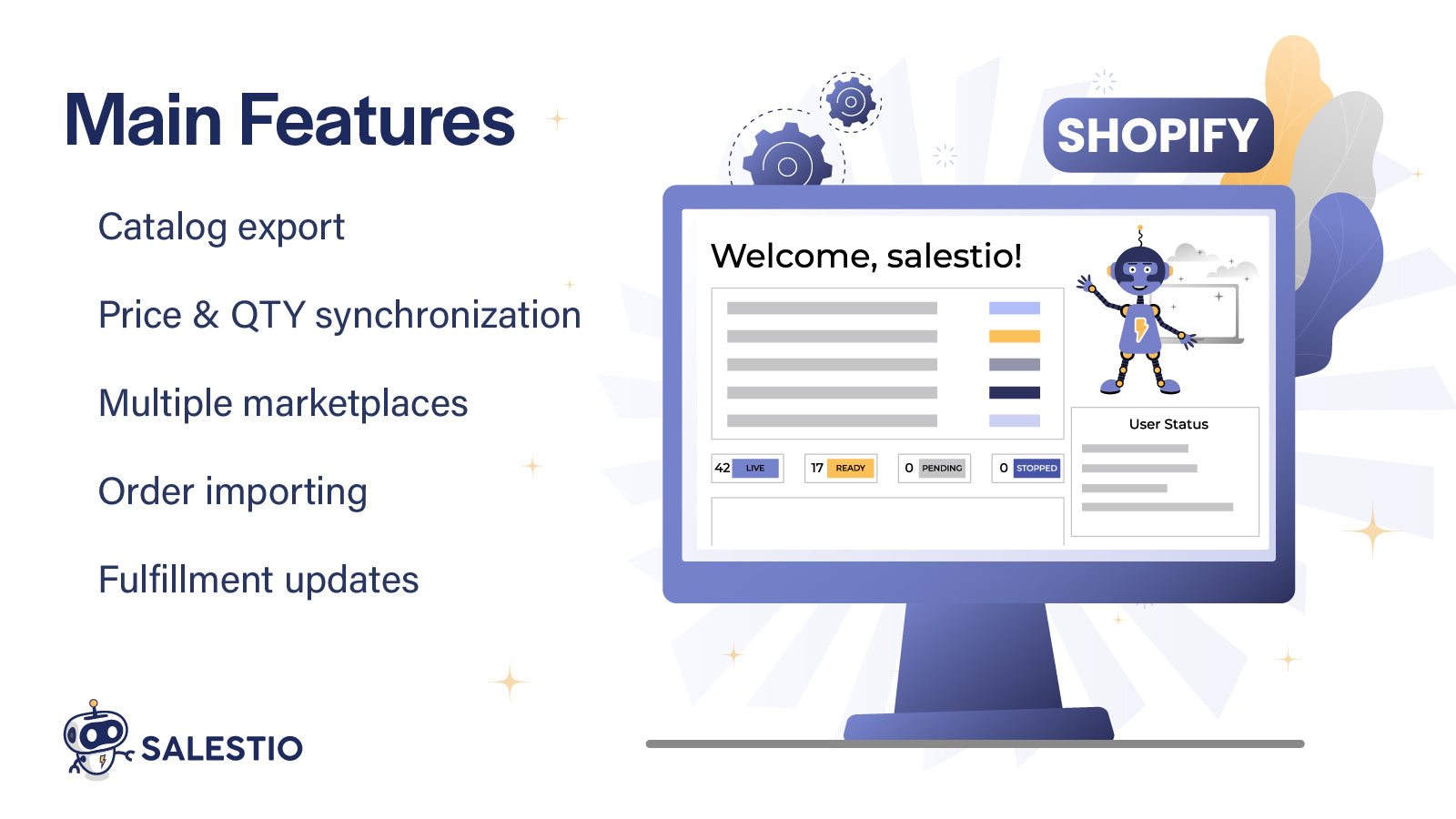
Salestio connecte votre boutique à Amazon sur 20 marketplaces régionales avec une synchronisation bidirectionnelle quasi en temps réel des produits, des stocks, des prix et des commandes. Il relie les produits de la boutique aux ASIN Amazon existants ou crée de nouvelles annonces, maintient l'exactitude des stocks gérés par le marchand et importe les commandes Amazon gérées par le marchand directement dans l'administration de votre boutique afin que le traitement des commandes et la comptabilité restent au même endroit. Les commandes FBA sont importées dans Salestio et apparaissent sur la page Commandes ; les transférer vers votre boutique est une option que vous activez dans les paramètres. Les règles de prix par marketplace vous permettent de définir des majorations spécifiques à Amazon, et la prise en charge multi-comptes gère les vendeurs ayant plus d'un compte Amazon. Comme il fonctionne à l'intérieur de Shopify, BigCommerce, WooCommerce, PrestaShop, Shopware ou Ecwid, il n'y a pas de tableau de bord séparé à gérer.

CedCommerce Amazon Channel
8.0/10Module Amazon dédié avec des fonctionnalités approfondies de catégorie et de flux.
CedCommerce Amazon Channel est un connecteur dédié avec des fonctionnalités spécifiques à Amazon approfondies, y compris le mappage de catégories et de nœuds de navigation, l'optimisation de flux basée sur des modèles et la gestion en masse des annonces. En tant que module ciblé, il offre aux vendeurs Amazon un contrôle granulaire sur la façon dont les produits sont structurés et publiés, et il gère l'importation des commandes et la synchronisation des stocks pour le canal. Les marchands qui vendent également sur d'autres marketplaces installent des modules CedCommerce supplémentaires, chacun avec son propre abonnement et sa propre configuration, de sorte que l'approche par canal échange la gestion unifiée contre une profondeur spécialisée sur chaque marketplace.
Visiter CedCommerce Amazon Channel →
Marketplace Connect (Codisto)
7.7/10Forte correspondance ASIN Amazon pour les vendeurs Shopify.
Marketplace Connect, le successeur de Codisto détenu par Walmart, offre une correspondance ASIN Amazon robuste qui aide les marchands Shopify à lier rapidement les produits existants aux entrées du catalogue Amazon, ainsi qu'une synchronisation bidirectionnelle des stocks et des commandes. Son orientation combinée Amazon et Walmart en fait un choix naturel pour les vendeurs ciblant les deux marketplaces depuis Shopify. La couverture est limitée à Shopify et à une poignée de canaux, de sorte que les marchands sur d'autres plateformes de boutique ou ceux qui s'étendent à Etsy et au-delà devraient confirmer que leurs exigences sont satisfaites. Pour une présence Amazon ciblée sur Shopify, sa correspondance ASIN et sa synchronisation native des commandes sont des atouts.
Visiter Marketplace Connect (Codisto) →
M2E Cloud
7.6/10Connecteur Amazon et eBay flexible avec un niveau gratuit utilisable.
M2E Cloud connecte les boutiques à Amazon et eBay avec une gestion flexible des annonces et des stocks, et un niveau gratuit qui permet aux marchands de démarrer sans frais initiaux. Il offre un contrôle granulaire sur les règles d'annonce et la synchronisation, ce qui attire les vendeurs qui souhaitent affiner la manière dont les produits sont mappés à Amazon. La flexibilité s'accompagne d'une courbe d'apprentissage de la configuration plus raide que celle des applications plus directives, de sorte que les nouveaux vendeurs peuvent avoir besoin de plus de temps de configuration. Pour les marchands à l'aise avec la configuration des règles et qui souhaitent une couverture Amazon et eBay à moindre coût, c'est une option performante.
Visiter M2E Cloud →
LitCommerce
7.4/10Connecteur Amazon économique pour les petits catalogues.
LitCommerce offre une voie abordable vers Amazon pour les petits vendeurs, avec un tableau de bord clair qui mappe les produits de la boutique aux annonces Amazon et récupère les commandes. Sa tarification à curseur publiée commence à 29 $ par mois et est basée sur un niveau d'annonces plus 5 $ par canal, ce qui maintient les coûts bas pour les catalogues modestes, et il se connecte à plus de 20 autres marketplaces si vous vous développez plus tard. La synchronisation est principalement basée sur des flux avec des mises à jour périodiques plutôt qu'en temps réel, de sorte que les stocks à rotation rapide peuvent prendre du retard, et les commandes sont gérées dans le tableau de bord LitCommerce plutôt qu'importées nativement. Il convient aux vendeurs soucieux de leur budget avec de petits catalogues Amazon.
Visiter LitCommerce →Tableau comparatif des fonctionnalités
Spécifications côte à côte que les vrais acheteurs comparent
| Fonctionnalité | Salestio | CedCommerce | Marketplace Connect | M2E Cloud | LitCommerce |
|---|---|---|---|---|---|
| Régions Amazon prises en charge | 20 régions | Multiples | US + pris en charge | Multiples | Multiples |
| Correspondance ASIN | Oui | Oui | Oui, solide | Oui | Basique |
| Synchronisation des stocks FBA | Non ; commandes FBA uniquement | Oui | Oui | Partielle | Limitée |
| Importation des commandes vers la boutique | Oui, commandes natives | Oui | Oui (Shopify) | Oui | Non ; dans le tableau de bord |
| Type de synchronisation | Bidirectionnel, en temps réel | Flux + commandes | Bidirectionnel | Quasi temps réel | Flux + commandes |
| Règles de prix Amazon | Règles par marketplace | Règles du module | Par canal | Basé sur des règles | Basique |
| Multi-compte | Oui | Par module | Limité | Oui | Limité |
| Modèle de tarification | Commandes/mois (29 $ / 79 $ / 199 $ / 299 $, dépassement plafonné) | Par application marketplace (commandes/mois dans chacune) | 1 % par commande synchronisée, plafonné à 99 $/mois | Niveau gratuit + payant | Niveau d'annonce + 5 $ par canal |
Comment choisir le bon outil
- Confirmez que l'outil couvre les régions Amazon dans lesquelles vous vendez. Si vous gérez plusieurs marketplaces Amazon, le support multi-régions et multi-comptes évite les configurations dupliquées.
- Vérifiez la qualité de la correspondance ASIN. Une correspondance précise avec les entrées existantes du catalogue Amazon empêche les annonces en double et accélère la mise en ligne de votre catalogue.
- Si vous utilisez FBA, vérifiez que le stock Fulfilled-by-Amazon est reflété dans votre inventaire disponible afin de ne pas survendre les unités détenues par Amazon.
- Décidez où les commandes Amazon doivent atterrir. L'importation native dans l'administration de votre boutique maintient un seul flux de traitement des commandes, tandis que les outils basés sur un tableau de bord impliquent de gérer les commandes séparément.
- Comparez le coût total au volume que vous gérez réellement, et non pas uniquement sur le modèle de tarification. À environ 500 commandes marketplace par mois, Salestio Growth coûte 79 $ et inclut 5 comptes marketplace, 10 000 produits et une synchronisation toutes les 15 minutes ; les commandes supplémentaires sont facturées par commande (0,15 $ sur Starter, jusqu'à 0,04 $ sur Scale et Ultimate) et plafonnées, de sorte que le pire scénario de chaque plan est le prix du plan suivant : Starter plafonne à 79 $, Growth à 199 $, Scale à 299 $. CedCommerce facture une fois par application marketplace, LitCommerce facture par niveau d'annonce plus 5 $ par canal, et les 1 % par commande synchronisée de Marketplace Connect varient avec la valeur de la commande. Les mêmes plans basés sur les commandes s'appliquent sur Shopify, BigCommerce, WooCommerce, Shopware et PrestaShop.
Questions fréquemment posées
Sources et références
Sources externes utilisées dans ce guide
- Salestio. Intégration Amazon sur le Shopify App Store [Annonce sur l'app store]
- Avis et évaluations de Salestio sur G2 [Avis indépendants]
- CedCommerce Amazon Channel sur le Shopify App Store [Annonce du concurrent]
- Shopify Marketplace Connect (Codisto) [Annonce du concurrent]
- M2E Cloud Intégration Amazon [Annonce du concurrent]
- Documentation Salestio. Configuration Amazon [Documentation produit]
- Documentation développeur Amazon SP-API [Documentation api]
- Présentation d'Amazon Fulfillment by Amazon (FBA) [Référence]
Prêt à connecter votre boutique à Amazon ?
Commencez votre essai gratuit de 14 jours et découvrez comment Salestio synchronise les produits, les stocks et les commandes Amazon directement dans l'administration de votre boutique, dans 20 régions Amazon. Plans basés sur les commandes publiés à partir de $29/mois, mois par mois, annulable à tout moment.