



TL;DR
The best Amazon integration tool keeps your store and Amazon in lockstep: accurate ASIN matching, real-time inventory, automatic order import, and per-region control. Salestio leads with store-native two-way sync across 20 Amazon regions and orders imported straight into your store admin, on published order-based plans from $29/month. CedCommerce Amazon Channel offers deep Amazon-specific features as a dedicated module, but each marketplace is a separate subscription. Marketplace Connect provides strong ASIN matching for Shopify sellers on Amazon and Walmart and charges 1% per synced order. M2E Cloud is a flexible free-tier option. LitCommerce is a budget pick for smaller catalogs.
Top 5 Marketplace Integration Apps
Ranked by sync depth, pricing transparency, and marketplace coverage

Salestio
9.3/10Store-native two-way Amazon sync across 20 regions with native order import.
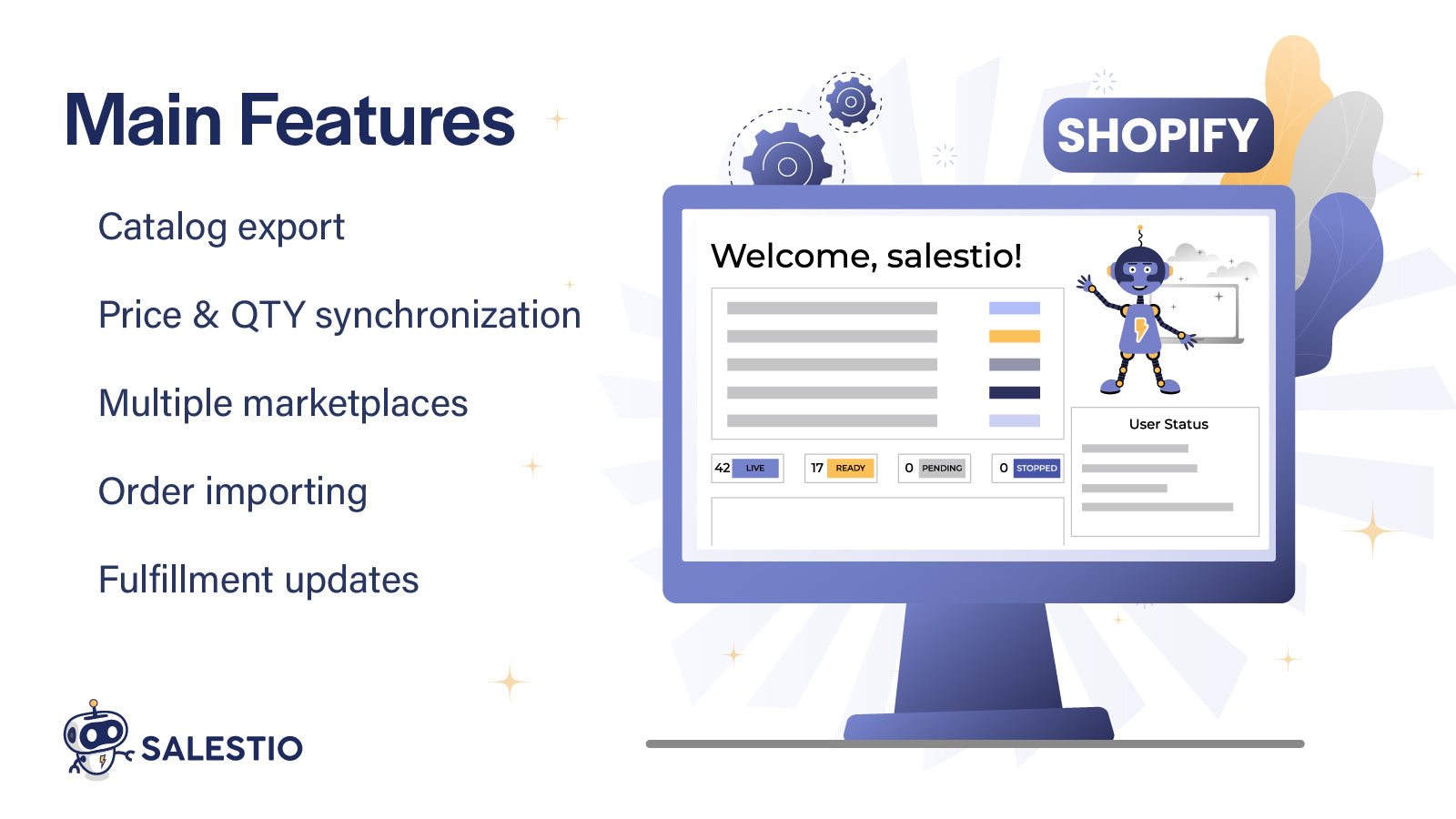
Salestio connects your store to Amazon across 20 regional marketplaces with near real-time two-way synchronization of products, inventory, pricing, and orders. It links store products to existing Amazon ASINs or creates new listings, keeps merchant-fulfilled stock accurate, and imports merchant-fulfilled Amazon orders directly into your store admin so fulfilment and accounting stay in one place. FBA orders are imported into Salestio and appear on the Orders page; pushing them through to your store is an option you enable in settings. Per-marketplace price rules let you set Amazon-specific markups, and multi-account support handles sellers with more than one Amazon account. Because it runs inside Shopify, BigCommerce, WooCommerce, PrestaShop, Shopware, or Ecwid, there is no separate dashboard to manage.

CedCommerce Amazon Channel
8.0/10Dedicated Amazon module with deep category and feed features.
CedCommerce's Amazon Channel is a dedicated connector with deep Amazon-specific functionality, including category and browse-node mapping, template-based feed optimization, and bulk listing management. As a focused module it gives Amazon sellers granular control over how products are structured and published, and it handles order import and inventory sync for the channel. Merchants who also sell on other marketplaces install additional CedCommerce modules, each with its own subscription and configuration, so the per-channel approach trades unified management for specialised depth on each marketplace.
Visit CedCommerce Amazon Channel →
Marketplace Connect (Codisto)
7.7/10Strong Amazon ASIN matching for Shopify sellers.
Marketplace Connect, the Walmart-owned successor to Codisto, offers robust Amazon ASIN matching that helps Shopify merchants link existing products to Amazon catalog entries quickly, plus two-way inventory and order sync. Its combined Amazon and Walmart focus makes it a natural fit for sellers targeting both marketplaces from Shopify. Coverage is limited to Shopify and a handful of channels, so merchants on other store platforms or those expanding to Etsy and beyond should confirm their requirements are met. For a focused Amazon presence on Shopify, its ASIN matching and native order sync are strengths.
Visit Marketplace Connect (Codisto) →
M2E Cloud
7.6/10Flexible Amazon and eBay connector with a usable free tier.
M2E Cloud connects stores to Amazon and eBay with flexible listing and inventory management and a free tier that lets merchants start without upfront cost. It offers granular control over listing rules and synchronization, appealing to sellers who want to fine-tune how products map to Amazon. The flexibility comes with a steeper configuration learning curve than more opinionated apps, so first-time sellers may need more setup time. For merchants comfortable configuring rules who want Amazon and eBay coverage on a budget, it is a capable option.
Visit M2E Cloud →
LitCommerce
7.4/10Budget Amazon connector for smaller catalogs.
LitCommerce offers an affordable route onto Amazon for smaller sellers, with a clean dashboard that maps store products to Amazon listings and pulls orders back. Its published slider pricing starts at $29 a month and is built from a listing tier plus $5 per channel, which keeps costs low for modest catalogs, and it connects to more than 20 other marketplaces if you expand later. Sync is primarily feed-based with periodic updates rather than real time, so fast-moving inventory can lag, and orders are managed in the LitCommerce dashboard rather than imported natively. It suits budget-conscious sellers with smaller Amazon catalogs.
Visit LitCommerce →Feature Comparison Table
Side-by-side specs that real buyers compare
| Feature | Salestio | CedCommerce | Marketplace Connect | M2E Cloud | LitCommerce |
|---|---|---|---|---|---|
| Amazon Regions Supported | 20 regions | Multiple | US + supported | Multiple | Multiple |
| ASIN Matching | Yes | Yes | Yes, strong | Yes | Basic |
| FBA Inventory Sync | No; FBA orders only | Yes | Yes | Partial | Limited |
| Order Import to Store | Yes, native orders | Yes | Yes (Shopify) | Yes | No; in dashboard |
| Sync Type | Two-way, real-time | Feed + orders | Two-way | Near real-time | Feed + orders |
| Amazon Price Rules | Per-marketplace rules | Module rules | Per-channel | Rule-based | Basic |
| Multi-account | Yes | Per module | Limited | Yes | Limited |
| Pricing Model | Orders/month ($29 / $79 / $199 / $299, capped overage) | Per marketplace app (orders/mo within each) | 1% per synced order, capped at $99/month | Free tier + paid | Listing tier + $5 per channel |
How to Choose the Right Tool
- Confirm the tool covers the Amazon regions you sell in. If you run more than one Amazon marketplace, multi-region and multi-account support avoid duplicated setups.
- Check ASIN matching quality. Accurate matching to existing Amazon catalog entries prevents duplicate listings and speeds up going live with your catalog.
- If you use FBA, verify that Fulfilled-by-Amazon stock is reflected in your available inventory so you do not oversell units that Amazon holds.
- Decide where Amazon orders should land. Native import into your store admin keeps one fulfilment workflow, while dashboard-based tools mean managing orders separately.
- Compare total cost at the volume you actually run, not on the pricing model alone. At roughly 500 marketplace orders a month Salestio Growth is $79 and includes 5 marketplace accounts, 10,000 products and 15-minute sync; extra orders are billed per order ($0.15 on Starter down to $0.04 on Scale and Ultimate) and capped, so every plan's worst case is the next plan's price: Starter tops out at $79, Growth at $199, Scale at $299. CedCommerce charges once per marketplace app, LitCommerce charges by listing tier plus $5 per channel, and Marketplace Connect's 1% per synced order moves with order value. The same order-based plans apply on Shopify, BigCommerce, WooCommerce, Shopware and PrestaShop.
Frequently Asked Questions
Sources & References
External sources used in this guide
- Salestio. Amazon Integration on Shopify App Store [App store listing]
- Salestio Reviews and Ratings on G2 [Independent reviews]
- CedCommerce Amazon Channel on Shopify App Store [Competitor listing]
- Shopify Marketplace Connect (Codisto) [Competitor listing]
- M2E Cloud Amazon Integration [Competitor listing]
- Salestio Documentation. Amazon Setup [Product documentation]
- Amazon SP-API Developer Documentation [Api documentation]
- Amazon Fulfillment by Amazon (FBA) Overview [Reference]
Ready to connect your store with Amazon?
Start your 14-day free trial and see how Salestio syncs products, inventory, and Amazon orders directly inside your store admin across 20 Amazon regions. Published order-based plans from $29/month, month-to-month, cancel anytime.