



TL;DR
For BigCommerce merchants expanding to Amazon, eBay, and Etsy in 2026, Salestio provides store-native two-way integration with real-time inventory sync and order import directly into BigCommerce, on published order-based plans from $29/month that cover all three marketplaces. Koongo offers broad marketplace feed coverage for merchants focused on product distribution, with base plans plus usage charges. CedCommerce provides per-marketplace extensions, each a separate subscription. ChannelAdvisor, now Rithum, suits enterprises with 100+ marketplace needs but publishes no pricing and bills a percentage of GMV. Sellbrite works for merchants wanting a standalone dashboard and meters orders per month.
Top 5 Marketplace Integration Apps
Ranked by sync depth, pricing transparency, and marketplace coverage

Salestio
9.3/10Store-native BigCommerce integration for Amazon, eBay, and Etsy with real-time sync and published order-based pricing.
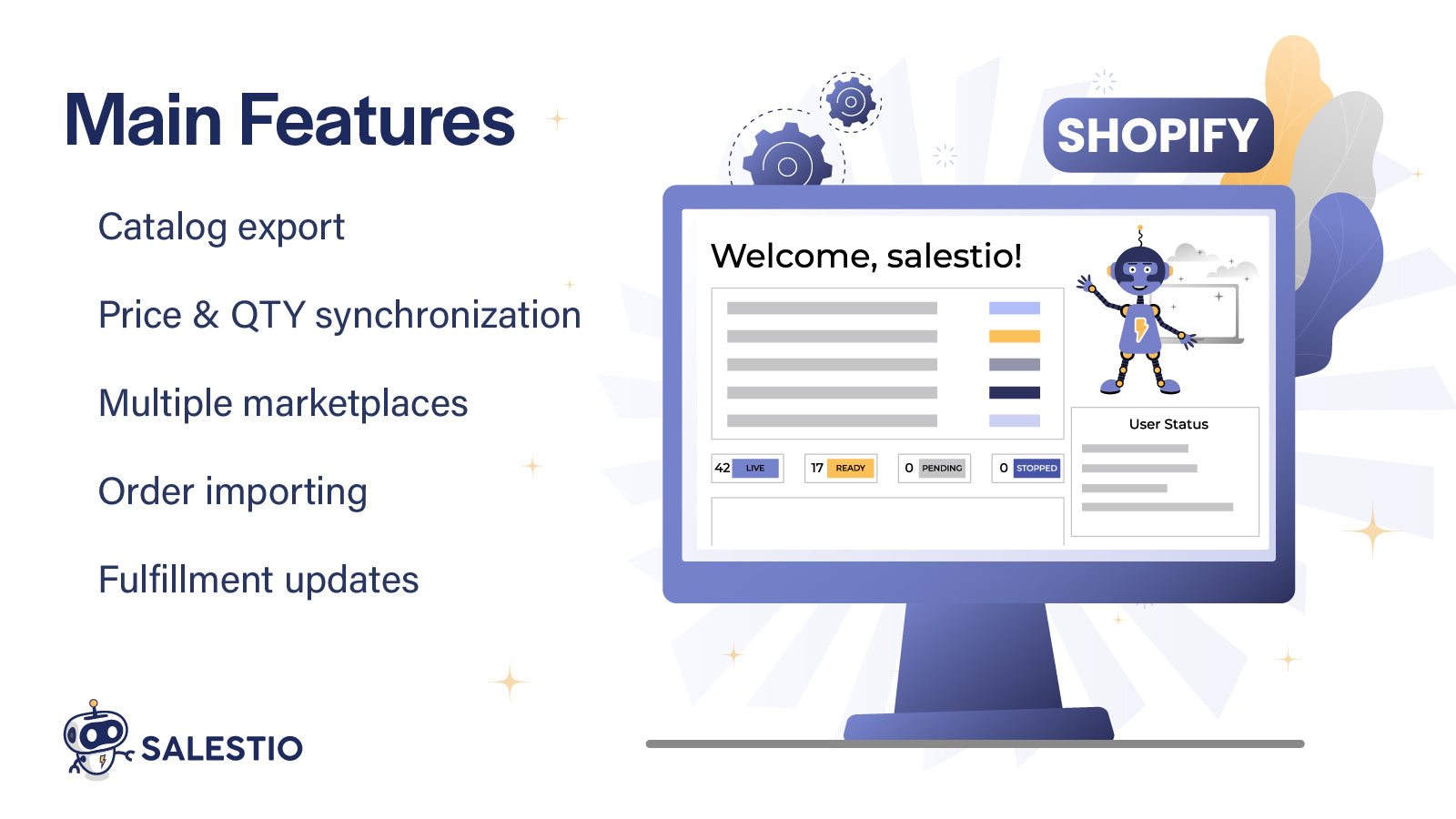
Salestio integrates natively into the BigCommerce control panel, delivering real-time two-way synchronization of products, inventory, orders, and pricing across Amazon, eBay, and Etsy. Pricing is order-based and published in full rather than quoted: Starter $29/month for 100 marketplace orders, Growth $79 for 500, Scale $199 for 3,000, Ultimate $299 for 7,000, plus a Custom tier, and the same plans apply on Shopify, WooCommerce, Shopware, and PrestaShop if you run more than one storefront. Extra orders are billed per order ($0.15 on Starter down to $0.04 on Scale and Ultimate) and capped, so every plan's worst case is capped at the next plan's price: Starter tops out at $79, Growth at $199, Scale at $299. Only marketplace orders imported into BigCommerce count toward the quota; your own storefront orders don't. The platform fully supports configurable products, variant mapping, per-marketplace price rules, eBay Motors fitment, and multi-currency operations. Merchants manage all marketplace orders within their existing BigCommerce fulfillment workflow without switching to an external dashboard.

Koongo
8.0/10Feed-based multichannel tool with 40+ marketplace connections and product data export focus.
Koongo specializes in product feed management, connecting BigCommerce stores to over 40 marketplaces and comparison shopping engines through automated data exports. It includes feed optimization features that let merchants tailor product data per channel, and it has a particularly strong presence in European markets. Koongo has restructured how it charges: a free tier plus base plans at €35, €69, and €99 per month chosen by sync frequency, with usage charges for extra items, orders, stores, and marketplaces billed on top, so the real monthly cost is usage-dependent and enterprise volumes are quote-only. The old "Ultimate" tier is no longer purchasable. Order import is available but basic compared to store-native solutions, and inventory sync intervals range from 30 to 60 minutes.
Visit Koongo →
CedCommerce
7.7/10Per-marketplace modules with BigCommerce app marketplace presence.
CedCommerce offers separate BigCommerce apps for individual marketplaces, allowing merchants to install only the connectors they require. Each module includes a setup wizard that guides sellers through channel configuration, product listing, and basic order import for its specific marketplace. The platform provides broad marketplace coverage spanning Amazon, eBay, Etsy, Walmart, and more. Nothing is bundled, though: each app is its own subscription metered on orders per month, so Amazon plus eBay plus Etsy means three bills and three configurations. This approach works well for sellers concentrating on one or two channels, but operational complexity climbs with each additional module.
Visit CedCommerce →
ChannelAdvisor
7.4/10Enterprise-grade multichannel platform with advanced automation and 100+ marketplace connections.
ChannelAdvisor, acquired by CommerceHub in November 2022 and unified under the Rithum brand in December 2023, is an enterprise multichannel commerce platform connecting to over 100 marketplaces globally. It offers advanced repricing algorithms, advertising management, and automation capabilities designed for high-volume sellers. Its two-way sync covers major marketplaces, and its order management is comprehensive. There is no published price list: the pricing page 404s, and Rithum's own fee specification confirms the model is a percentage of GMV plus a percentage of ad spend, in progressive tiers with rates set per Order Form. Third-party reports put a single module at $12,000–18,000/year, mid-tier deployments at $18,000–30,000+/year, and enterprise at $30,000–50,000+/year, but those are not vendor figures. This is one of the few places where the fixed-monthly-versus-revenue-share contrast genuinely holds: Salestio bills a published monthly fee based on orders imported, not a share of what you sell.
Visit ChannelAdvisor →
Sellbrite
7.1/10GoDaddy-owned standalone multichannel listing and inventory tool.
Sellbrite, owned by GoDaddy, provides a clean standalone UI for multichannel listing and inventory management across Amazon, eBay, Etsy, and Walmart. It is a good fit for merchants wanting simplicity, as its interface focuses on ease of use over advanced configuration. Its periodic batch sync updates inventory at regular intervals rather than in real time. Like Salestio it is metered on orders per month rather than catalog size, so compare inclusions at your volume: the Pro family runs Free / $29 / $79 / $179 at 30 / 100 / 500 / 2,000 orders per month, with 10,000 orders and above split into a separate Power family from $399 after the ladder changed in late 2025, and FBA orders are excluded from the count. The free tier covers up to 30 orders a month, making it accessible for small BigCommerce merchants exploring marketplace expansion without committing to a paid subscription upfront.
Visit Sellbrite →Feature Comparison Table
Side-by-side specs that real buyers compare
| Feature | Salestio | Koongo | CedCommerce | ChannelAdvisor | Sellbrite |
|---|---|---|---|---|---|
| Supported Marketplaces | Amazon, eBay, Etsy | 40+ including Amazon, eBay, Etsy | Amazon, eBay, Etsy, Walmart, +others | 100+ globally | Amazon, eBay, Etsy, Walmart |
| Sync Type | Two-way, real-time | One-way feed + basic order import | One-way + order import | Two-way | Periodic batch |
| Order Import to BigCommerce | Yes, directly | Basic import | Basic, per module | Yes | No; in Sellbrite dashboard |
| Price Rules | Per-marketplace markup/markdown | Feed-level price rules | Per-module | Advanced repricing | Basic markup |
| Inventory Sync Speed | Near real-time (<5 min) | 30-60 min intervals | Varies by module | Near real-time | 15-60 min intervals |
| Multi-currency Support | Yes | Basic | Per-module | Yes | Basic |
| eBay Motors Fitment | Yes | No | Via specific module | Yes | No |
| Free Trial | 14-day free trial on all paid plans | Free tier | Trial per module | Demo required | Free plan up to 30 orders/month |
| Pricing Model | Orders/month, published ($29 / $79 / $199 / $299, capped overage) | Base plan by sync frequency + usage charges | Per marketplace app (orders/mo within each) | % of GMV + % of ad spend, quote-only | Orders/month (Free / $29 / $79 / $179, then Power tiers) |
| Entry Price | $29/month (Starter, 100 marketplace orders/mo) | Free tier, then €35/month base + usage | From $9/month per marketplace app | Not published; third-party reported $12,000–18,000/year for a single module | Free up to 30 orders/month |
How to Choose the Right Tool
- Verify native BigCommerce support. Some tools treat BigCommerce as a secondary platform with limited features compared to their Shopify offerings. Confirm that product sync, order import, and inventory updates work fully within the BigCommerce control panel.
- Assess sync direction and latency. Two-way real-time sync prevents overselling during peak traffic, while feed-based or batch-sync tools may introduce inventory discrepancies that require manual correction.
- Match the tool to your marketplace count. If you sell on one or two marketplaces, a focused connector may suffice. If you plan to expand to five or more channels, choose a tool that scales without requiring separate modules for each.
- Evaluate total cost of ownership at a volume you can name, and check whether the price is published at all. Rithum (ChannelAdvisor) doesn't publish one: its model is a percentage of GMV plus a percentage of ad spend, with third-party reports putting a single module at $12,000–18,000/year. Salestio's grid is public and order-metered, so at roughly 500 marketplace orders a month you are on Growth at $79 with 5 marketplace accounts, 10,000 products, and 15-minute sync, and overage is billed per order and capped at the next plan's price. Koongo's base plan is only part of its bill, since items, orders, stores, and marketplaces are charged as usage on top.
- Run a trial with your actual catalog. Product data complexity, variant structures, and category mappings vary widely. Test with real products to confirm that listings, images, and attributes transfer correctly before committing.
Frequently Asked Questions
Sources & References
External sources used in this guide
- Salestio - Amazon Integration on BigCommerce App Marketplace [App store listing]
- Salestio Reviews and Ratings on G2 [Independent reviews]
- Salestio Pricing, Alternatives & More on Capterra [Independent reviews]
- Koongo - Marketplace Integration Platform [Competitor website]
- CedCommerce - Multichannel Marketplace Integration [Competitor website]
- Rithum (formerly ChannelAdvisor) - Commerce Operations Platform [Competitor website]
- Sellbrite - Multichannel Listing Software [Competitor website]
- Salestio Documentation - BigCommerce Integration Setup [Product documentation]
- Amazon SP-API Developer Documentation [Api documentation]
- eBay REST API Documentation [Api documentation]
- Etsy Open API v3 Documentation [Api documentation]
Ready to connect BigCommerce with Amazon, eBay, and Etsy?
Start your 14-day free trial and see how Salestio syncs products, inventory, and orders directly inside your BigCommerce control panel. No external dashboard required. Published order-based plans from $29/month, month-to-month, cancel anytime.