



TL;DR
The best marketplace integration software in 2026 depends on your platform mix and how deep a sync you need. Salestio leads for merchants who want real-time two-way sync and marketplace orders imported straight into their store admin, on published order-based plans from $29/month that cover every marketplace. CedCommerce offers the broadest platform and marketplace coverage, but through modular apps you subscribe to one at a time. LitCommerce is a listing-and-channel priced connector for smaller catalogs, from $29/month. Marketplace Connect is Shopify's own first-party app for Amazon and Walmart and charges 1% per synced order. ChannelEngine suits larger European brands needing enterprise feed control and quotes privately. Sellbrite fits sellers who prefer a standalone multichannel dashboard and is metered on orders per month.
Top 6 Marketplace Integration Apps
Ranked by sync depth, pricing transparency, and marketplace coverage

Salestio
9.4/10Store-native, real-time two-way marketplace integration on published order-based pricing.
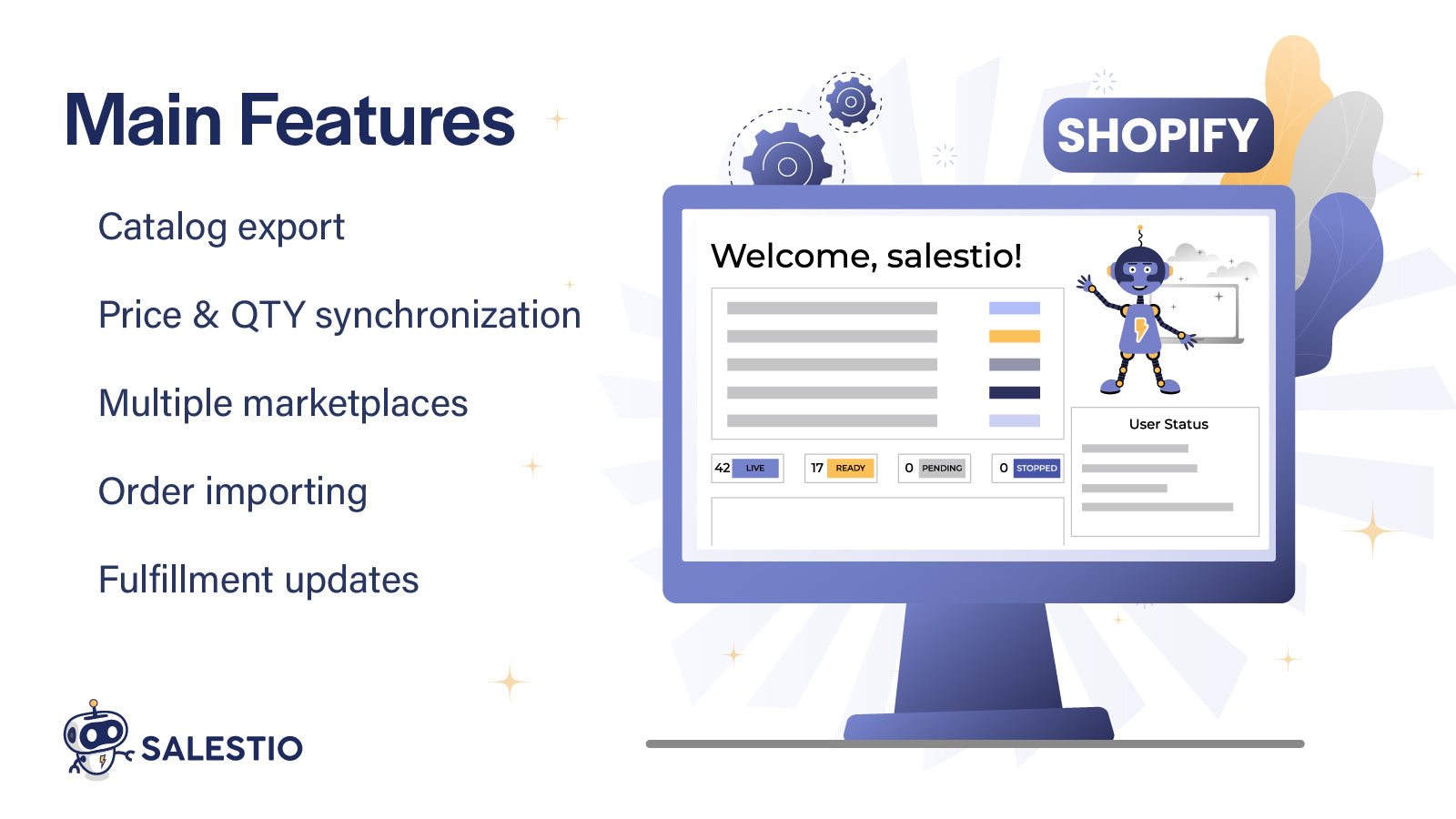
Salestio integrates directly into supported store platforms including Shopify, BigCommerce, WooCommerce, PrestaShop, Shopware, and Ecwid, providing near real-time two-way synchronization of products, inventory, orders, and pricing across Amazon, eBay, and Etsy. Marketplace orders are imported as native store orders, so merchants keep their existing fulfillment workflow instead of switching to an external dashboard. Pricing is order-based and published in full rather than quoted on a call: Starter $29/month for 100 marketplace orders, Growth $79 for 500, Scale $199 for 3,000, Ultimate $299 for 7,000, plus a Custom tier for unlimited volume. Extra orders are billed per order ($0.15 on Starter down to $0.04 on Scale and Ultimate) and capped, so every plan's worst case is capped at the next plan's price: Starter tops out at $79, Growth at $199, Scale at $299. The same order-based plans apply on Shopify, BigCommerce, WooCommerce, Shopware and PrestaShop, and one plan covers Amazon, eBay, and Etsy with no per-marketplace licence. Advanced features include per-marketplace price rules, multi-account connections, eBay Motors fitment, and Etsy personalisation support.

CedCommerce
8.0/10Broadest platform and marketplace coverage through per-marketplace modules.
CedCommerce offers one of the widest ranges of marketplace connectors in the market, with dedicated apps for dozens of channels available across Shopify, BigCommerce, WooCommerce, and Magento. Its modular architecture lets merchants install only the connectors they need, with each module handling product mapping, feed optimization, and order import for its marketplace, metered on orders per month with its own listing and product caps. This breadth makes it attractive for sellers targeting less common channels. The trade-off is that nothing is bundled: selling on Amazon, eBay, and Etsy means three separate subscriptions, three configurations, and three bills, where a single Salestio plan covers all three.
Visit CedCommerce →
LitCommerce
7.9/10Multi-channel connector priced by listing count plus a per-channel fee.
LitCommerce is a multichannel listing tool with a clean, centralized dashboard that connects a store to more than 20 marketplaces. Its slider-based "Pay As You Go" pricing starts at $29/month and is assembled from a listing tier ($14 at 1,000 listings rising to $414 at 200,000) plus $5 for every channel connected, with a ceiling around $489. Orders are unlimited and never metered, so a small catalog with heavy order flow stays cheap. The costs move the other way instead: each additional marketplace is a real per-channel fee, and orders live in the LitCommerce dashboard rather than importing into your store. It suits sellers with modest catalogs who prioritise price over real-time sync depth.
Visit LitCommerce →
Marketplace Connect (Codisto)
7.6/10Shopify's own first-party connector for Amazon and Walmart, billed as a percentage of order value.
Marketplace Connect, formerly Codisto, was relaunched as a Shopify first-party app in July 2023 and provides two-way sync between the store and its supported marketplaces. Deep Amazon ASIN matching helps merchants link existing store products to Amazon catalog entries efficiently, and its tight Walmart Marketplace integration makes it a strong choice for sellers whose primary expansion targets are Amazon and Walmart. It is one of the few tools here billed on a share of revenue rather than a flat fee: the first 50 synced orders each month are free, then 1% of every synced order up to a $99/month cap. Etsy is not supported, and it is Shopify-only, with no BigCommerce, WooCommerce, Shopware, or PrestaShop version, so merchants on or moving to those platforms need a different tool.
Visit Marketplace Connect (Codisto) →
ChannelEngine
7.4/10Enterprise marketplace management for larger European brands.
ChannelEngine is an enterprise-grade marketplace management platform with strong coverage of European channels such as Bol, Zalando, and Kaufland alongside Amazon and eBay. It offers sophisticated repricing, content management, and order orchestration aimed at mid-market and enterprise brands with dedicated e-commerce teams. It does not publish prices: the Start, Grow, and Scale plans show quotas only, and the commercial model is an onboarding fee plus a monthly licence plus a success fee on incremental GMV, metered on GMV, SKU count, and business units rather than per order or per marketplace. Third-party reports put entry around $200+/month, growth around $500+/month, and scale around $1,000+/month, but those are not vendor figures and only an Order Form will tell you your real number. That, plus implementation complexity, makes it less suited to small and mid-sized merchants who want a self-serve app with a price they can read before talking to anyone.
Visit ChannelEngine →
Sellbrite
7.2/10GoDaddy-owned standalone multichannel listing dashboard.
Sellbrite, owned by GoDaddy, is a standalone multichannel listing and inventory management dashboard connecting to Amazon, eBay, Etsy, and Walmart. Its separate-dashboard model suits merchants who prefer to manage marketplace operations outside their store admin. Batch sync updates inventory at regular intervals rather than in real time, which can introduce lag during high-volume periods, and orders are managed in the Sellbrite interface rather than imported into the store. It is order-metered like Salestio, so compare at your volume rather than on model: the Pro family runs Free / $29 / $79 / $179 at 30 / 100 / 500 / 2,000 orders per month, and 10,000 orders and above moved into a separate Power family from $399 when the ladder changed after October 2025. FBA orders are excluded and the FBA add-on is $19/month. A free tier for up to 30 orders a month makes it a low-risk starting point.
Visit Sellbrite →Feature Comparison Table
Side-by-side specs that real buyers compare
| Feature | Salestio | CedCommerce | LitCommerce | Marketplace Connect | ChannelEngine |
|---|---|---|---|---|---|
| Supported Marketplaces | Amazon, eBay, Etsy | Amazon, eBay, Etsy, Walmart, +others | Amazon, eBay, Etsy, +20 | Amazon, Walmart, eBay | Amazon, eBay, Bol, Zalando, +200 |
| Sync Type | Two-way, real-time | One-way feed + order import | One-way feed + order import | Two-way | Feed-based + order flow |
| Order Import to Store | Yes, directly | Basic, per module | No; in LitCommerce dashboard | Yes | Yes |
| Supported Platforms | Shopify, BigCommerce, WooCommerce, PrestaShop, Shopware, Ecwid | Shopify, BigCommerce, WooCommerce, Magento | Shopify, WooCommerce, Wix, +others | Shopify only | Custom / enterprise |
| Inventory Sync Speed | Near real-time (<5 min) | Varies by module | 15-30 min intervals | Near real-time | Scheduled |
| Price Rules | Per-marketplace markup/markdown | Per-module rules | Basic price adjustment | Per-channel pricing | Advanced repricing |
| Pricing Model | Orders/month, published ($29 / $79 / $199 / $299, capped overage) | Per marketplace app (orders/mo within each) | Listing count + $5 per channel | 1% per synced order, capped at $99/month | Quote-only: licence + success fee on incremental GMV |
| Free Trial | 14-day free trial on all paid plans | Trial per module | Paid from $29/month | Free to install; first 50 synced orders/mo free | Demo only |
| Best Fit | Real-time two-way sync + orders | Widest channel coverage | Small budget catalogs | Amazon + Walmart | Enterprise EU brands |
How to Choose the Right Tool
- Confirm the software supports every platform your store runs on and every marketplace you sell on today or plan to add. Bolting on a second tool later fragments your data and duplicates workflows.
- Evaluate sync direction and speed. Two-way real-time sync prevents overselling and keeps prices consistent, while one-way feeds and batch schedules can lag and cause stock discrepancies during busy periods.
- Decide where marketplace orders should live. Software that imports orders into your store admin lets you keep one fulfillment process, while standalone dashboards mean switching between systems.
- Model total cost at a named volume rather than comparing pricing models in the abstract. At roughly 500 marketplace orders a month Salestio Growth is $79 and includes 5 marketplace accounts, 10,000 products, and 15-minute sync; Sellbrite's 500-order Pro tier is $79 in a standalone dashboard; LitCommerce doesn't meter orders but charges a listing tier plus $5 per channel; CedCommerce bills one subscription per marketplace, so three channels means three of them.
- Find out whether you can even see the price before you commit. Salestio publishes its whole grid and caps overage so each plan's worst case is the next plan's price ($79, $199, $299), with a 14-day free trial, month-to-month billing, no setup fee and no revenue share. ChannelEngine quotes privately and adds a success fee on incremental GMV; Marketplace Connect takes 1% of each synced order. Use the trial to verify product mapping, category assignment, and inventory sync against your real catalog before committing to a paid plan.
Frequently Asked Questions
Sources & References
External sources used in this guide
- Salestio. Marketplace Integration on Shopify App Store [App store listing]
- Salestio Reviews and Ratings on G2 [Independent reviews]
- Salestio Pricing, Alternatives & More on Capterra [Independent reviews]
- CedCommerce Marketplace Integrations [Competitor listing]
- LitCommerce Multichannel Selling Tool [Competitor listing]
- Shopify Marketplace Connect (Codisto) [Competitor listing]
- ChannelEngine Marketplace Management [Competitor listing]
- Sellbrite Multichannel Listing Tool [Competitor listing]
- Salestio Documentation. Integration Setup [Product documentation]
- Amazon SP-API Developer Documentation [Api documentation]
- eBay REST API Documentation [Api documentation]
- Etsy Open API v3 Documentation [Api documentation]
Ready to connect your store with Amazon, eBay, and Etsy?
Start your 14-day free trial and see how Salestio syncs products, inventory, and orders directly inside your store admin. No external dashboard required. Published order-based plans from $29/month, month-to-month, cancel anytime.